Marked by the Cross
Artists find inspiration in many places — a cherished memory, a striking landscape, a fleeting moment of beauty. For Wade Mathers, one inspiration can be traced back to a single crucifix he encountered more than three decades ago.
In 1991, while studying art in Dickinson, North Dakota, Wade joined a small group of students on a van trip led by a professor to explore the artistic richness of Santa Fe, New Mexico. Along the way, they stopped at a small adobe chapel just outside the city: El Santuario de Chimayó. Inside, Wade observed a crucifix depicting Christ’s suffering in a much more graphic way — an approach typical of many Hispanic Catholic traditions.
“In our region, we tend to have more sanitized depictions of Jesus on the cross,” Wade explains. “I was struck by how much more realistic this style was — closer to what a crucifixion might have actually looked like.”
The image stayed with him.
At the time, Wade’s artistic expression was mostly two-dimensional. He painted, drew, worked with printmaking and created portraits. Sculpture was something he had barely explored, aside from a few moments at a potter’s wheel and a single attempt at a clay bust of his wife. Yet the memory of that crucifix in Chimayó stayed with him. Over the years, he found himself thinking about it — wishing he could have something similar in his own home.
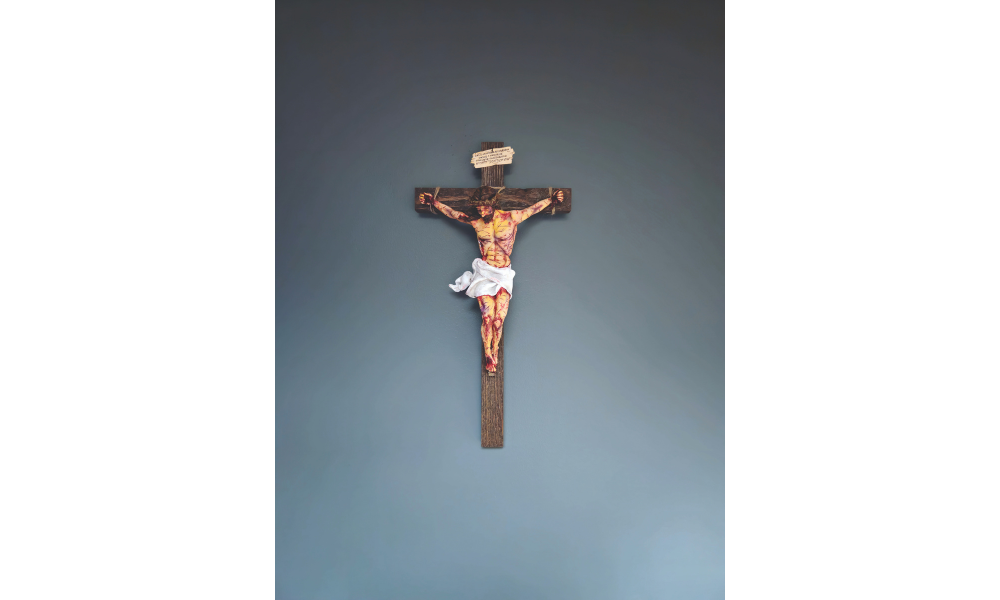
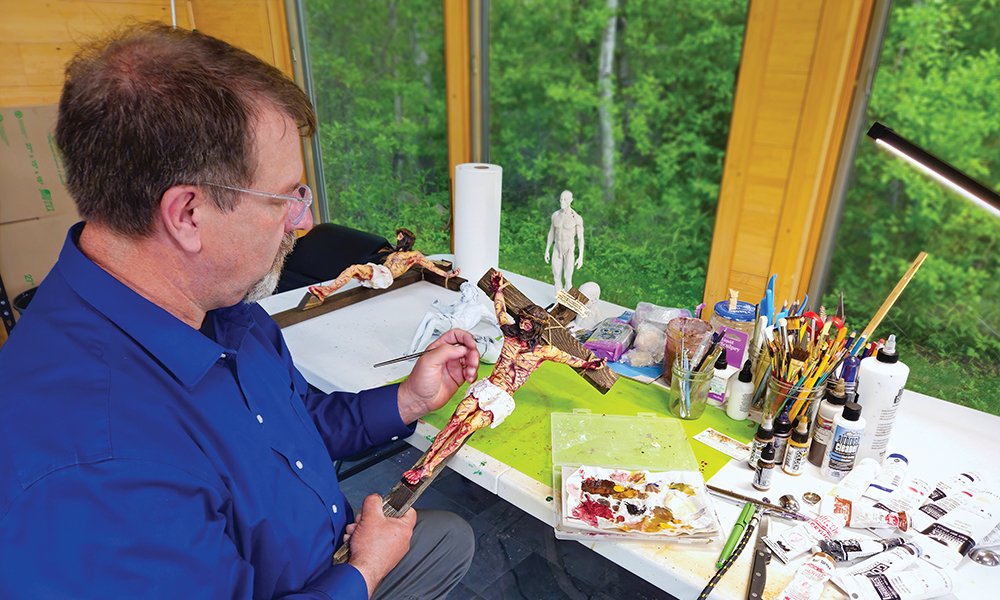
Seven years ago, Wade decided to try creating his own version of the crucifix he had seen in Chimayó. Unable to find one that matched what he envisioned — at least not without significant cost — he set to work. He began with a simple resin crucifix, carefully removing and reshaping the corpus. He drilled small holes to insert real nails, added a crown of thorns made from local buckthorn, and painted wounds and scars with painstaking attention. The cross itself was fashioned from natural wood, shaped from branches, with a small piece of birch bark used for the message placed above Christ’s head.
As Wade began the work, the process gradually became more than artistic. He started building his first crucifix during Lent, and in time, the work itself took on the shape of prayer, culminating on Good Friday — the day the Lord died on the cross.
“That first one still hangs in our home,” he says. It marked the beginning of a passion that would continue to grow over time.
Others began to notice. A brother-in-law requested a larger version. Father Scott Padrnos saw it and asked for another — larger still. Without any advertising or promotion, interest continued to spread. People encountered the crucifixes and were struck by their realism, often drawn to them as a means of deepening their own prayer. Many wanted one for themselves.
Over time, Wade created more — each one unique, each shaped by both artistic growth and spiritual reflection. Eventually, he reached a point where he wanted to move beyond modifying existing figures and instead design his own corpus from scratch.
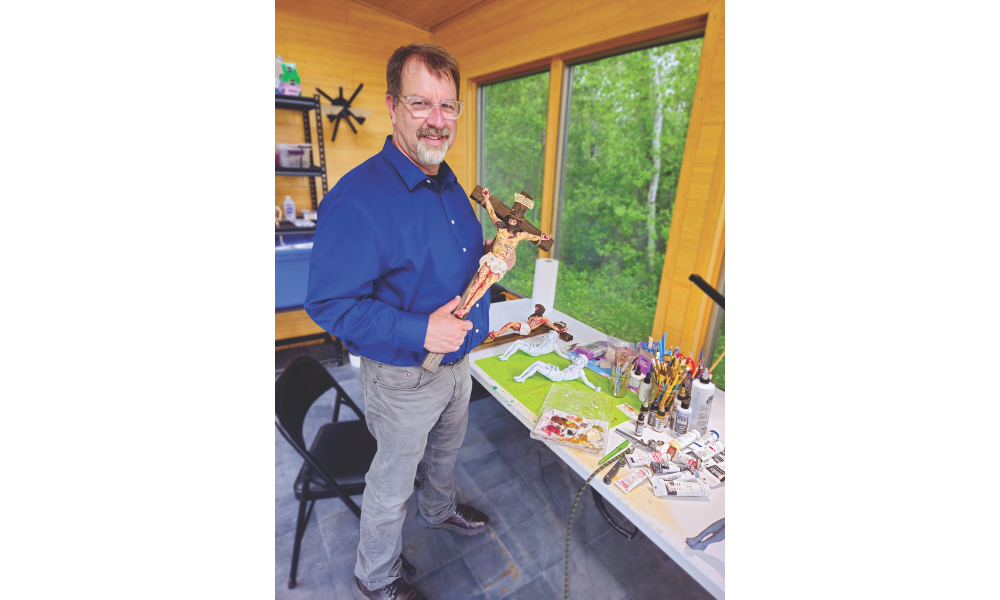
Despite having little experience in sculpture, Wade began the assiduous process of learning. He experimented with different clays, studied molding techniques and taught himself through trial and revision. Over time, he began to discover which materials would hold their form and which details translated best into molds, with each attempt refining the next.
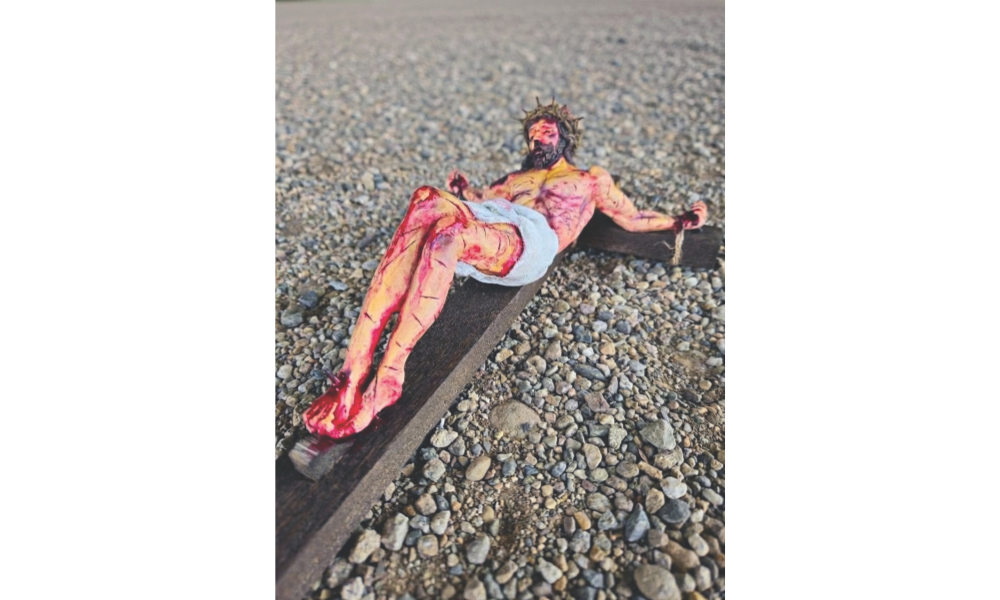
Like a painter producing prints, Wade had molds created of his sculptures and multiple castings. Even so, he approaches each piece individually. Each corpus is painted by hand, layered with bruising, wounds and lifelike detail. He uses a serrated knife to carve scars, a Dremel tool to create openings for nails and thorns and carefully inserts each thorn and nail by hand.
No two are the same.
This realism often leaves an impression on those who encounter his work. Wade says reactions generally fall into three categories. Many are deeply moved, drawn into a more profound reflection on Christ’s suffering. Some, often priests, suggest making the depictions even more intense. Others find the realism difficult to look at.
For Wade, the intention is not to shock, but to invite prayerful reflection.
“As I’m working,” he says, “there are moments — especially when I’m driving the nails — that I stop and think about what Jesus endured. It can bring me to tears.”
Each mark he carves becomes personal. Each wound becomes a point of connection.
“With every scar I add, I find myself wondering how many times I contributed to these through my own sin,” he reflects. “It becomes a prayer.”
That sense of prayer extends beyond the creation process. Wade keeps a written log of each crucifix he has made and where it has gone — across the country and even around the world. He includes each recipient in his daily prayer book, offering prayers long after the crucifix leaves his hands.
To date, he has made and given away more than fifty crucifixes. He has never sold one. When people insist on offering something in return, he asks them instead to donate to one of the diocesan Catholic schools.
The impact of his work continues to ripple outward — given as wedding gifts, placed in homes and even used by priests as gifts for newly ordained men.
Yet for Wade, the greatest significance is not found in recognition or demand. He finds it deeply humbling that his work and talents can be used by God to help others in prayer.
What started as an artist’s memory of a crucifix in a small New Mexico chapel has grown into a passion — one that has shaped not only the figure of Christ, but the artist himself.
Each piece begins with clay, wood, paint and tools. Each one ends as something more than art — a reflection of suffering, sacrifice and love. In between, in every cut, every stroke of paint and every driven nail, Wade Mathers continues to pray.