Buen Camino
Father Jacob Toma’s Camino Pilgrimage to the Tomb of St. James
Father Jacob Toma’s Camino Pilgrimage to the Tomb of St. James
Each year, Catholic priests are required to make an annual retreat of at least five days. For some, that means silence in a retreat house. For others, it may involve spiritual conferences or directed prayer.
Each year, Catholic priests are required to make an annual retreat of at least five days. For some, that means silence in a retreat house. For others, it may involve spiritual conferences or directed prayer.
For Father Jacob Toma, this year’s retreat meant lacing up a pair of hiking shoes, putting everything he needed into a backpack, and joining hundreds of fellow pilgrims on one of Christianity’s most famous journeys: the Camino de Santiago.
“I’m still figuring out what kind of retreat works best for me,” Father Toma admits. “Do I like silent retreats? Do I need something more active? Do I like being around people or being by myself?”
The answer this year came in the form of the Camino, a centuries-old pilgrimage ending at the Cathedral of Santiago de Compostela in Spain, where the relics of St. James the Apostle are venerated. For more than 1,000 years, pilgrims have traveled the network of routes leading to Santiago, seeking spiritual renewal, personal reflection and a deeper encounter with God.
Father Toma was no stranger to the experience.
While studying at the seminary in Rome, he completed the pilgrimage for the first time, participating in a tradition many seminarians have embraced over the years.
“Seminarians are creatures of habit,” he jokes. “Everybody stays at the same places, walks the same route and has pretty much the same experience.”
This summer, however, he returned with a priest friend from the Diocese of Joliet, Illinois, choosing to walk the final 101 kilometers of the Portuguese Camino. Beginning near Porto, Portugal, the route winds through rolling countryside, vineyards and centuries-old villages before converging on Santiago, Spain.
The journey began with little preparation.
Looking back, Father Toma laughs that this may have been his final “young man’s trip.”
“I thought, maybe this will be the last time I can just show up without training and hope for the best.”
After a night of travel with less than three hours of sleep, he found himself tackling steep hills while dehydrated and running largely on determination.
“You only have a small window as a priest to do things like this,” he says. “So I just hit the ground running.”
Yet the challenge is part of what makes the Camino unique.
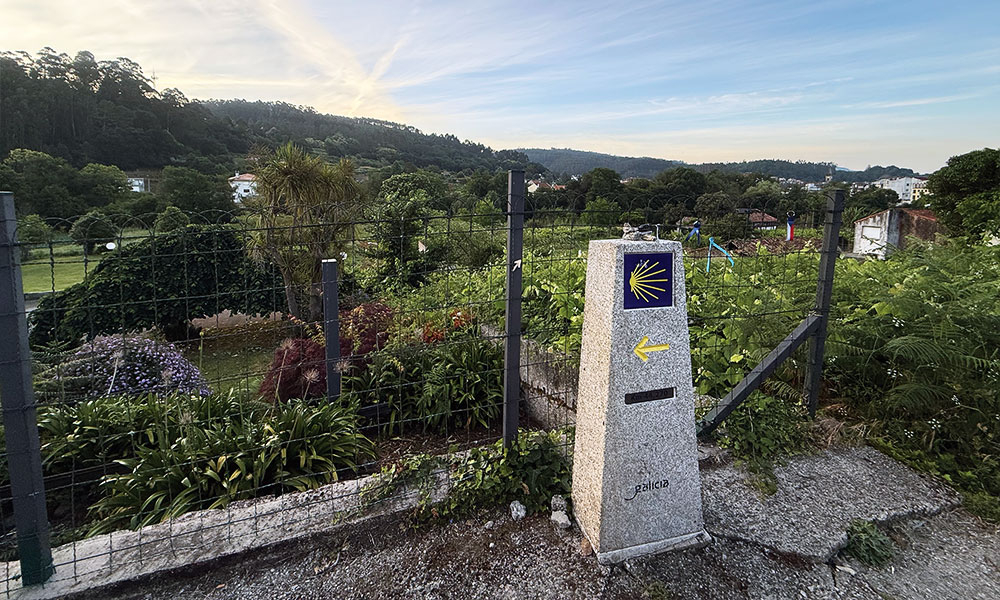
Pilgrims spend hours each day walking, praying, reflecting and meeting fellow travelers from around the world. Along the trail, roadside markers count down the remaining kilometers to Santiago, providing both encouragement and direction.
The symbol of the Camino is the scallop shell marked with the Cross of St. James. Its design reflects the pilgrimage itself. Just as the shell’s lines converge at a single point, pilgrims travel from many different routes across Europe toward one destination: the tomb of the apostle.
Traditionally, pilgrims collect a shell at the beginning of their journey and carry it to Santiago as a reminder of the path they have traveled.
Although the Camino provides ample time for personal prayer and reflection, pilgrims rarely walk alone for long. Day after day, the same faces appear along the trail and at evening Masses in the villages they pass through. Conversations shared among people from different countries, cultures and walks of life, all traveling toward the same destination.
“It really gives you a sense that we’re a pilgrim Church,” Father Toma says.
Being a priest on the Camino often made him easy to spot. Although he did not wear his clerical collar while walking, fellow pilgrims eventually discovered he and his companion were priests. Before long, they were hearing confessions, answering questions about the faith and accompanying fellow travelers on their spiritual journeys.
For Father Toma, these encounters became one of the most memorable parts of the pilgrimage.
“You have a lot of secular people walking the Camino,” he says. “Some don’t know much about Catholicism or even about God. But along the way, they’re exposed to the faith and end at this magnificent cathedral built around the tomb of an apostle.”
The experience became unexpectedly missionary.
“It was beautiful being able to shepherd people and expose them to the life of Christ.”
The pilgrimage also offered Father Toma a glimpse into the challenges facing the universal Church.
Spain, long considered one of the historic centers of Catholicism, is experiencing a severe priest shortage. Speaking with local clergy, he learned that retirement is often not an option.
One priest in his early 60s explained that as long as a priest remains healthy, he continues serving. Many oversee four or five parishes at a time.
Father Toma was particularly struck by a 92-year-old priest who still celebrated Mass despite being basically blind.
On all but one evening of the pilgrimage, Father Toma and his friend were invited to celebrate Mass in place of local priests, providing some welcome relief.
“People weren’t used to seeing young priests,” he says.
The conversations and encounters enriched the pilgrimage, but so did the long hours of walking.
The Camino is designed to provide time to think, time to pray and time simply to be with the Lord.
Father Toma found himself reflecting on St. James himself, who would have spent countless hours traveling between communities while carrying out his apostolic mission.
“In our world, everything is so busy,” he says. “We don’t always have that time to just be with the Lord.”
Those stretches of uninterrupted prayer became one of the greatest gifts of the journey.
Not every moment along the Camino felt deeply spiritual.
“There were definitely days that felt like one big hill,” he laughs.
On those stretches, he kept moving with the help of a little humor and a pair of songs that seemed to surface again and again: Ain’t No Mountain High Enough and Bon Jovi’s Livin’ on a Prayer.
“Approaching the top of one hill, I remember singing, ‘Whoa, we’re halfway there!’ You do what you have to do.”
After days on the trail, Father Toma finally arrived in Santiago. Along with hundreds of pilgrims from various Camino routes, he entered the cathedral housing the tomb of St. James.
Pilgrims descend into the crypt to pray before the apostle’s tomb before climbing behind the altar to embrace the famous statue of St. James. A special Mass follows, with pilgrims from around the world gathered together to celebrate reaching their destination.
Father Toma carried a particular intention throughout his retreat, offering the pilgrimage for his brother priests.
At its conclusion, he received the Compostela certificate, recognizing completion of the Camino as a religious pilgrimage, along with the indulgence associated with the journey.
There was one final memory he could not resist.
Leaving the Mass, the pilgrims passed by the cathedral’s famous Botafumeiro, the enormous silver thurible weighing more than 100 pounds that swings dramatically through the church.
Father Toma’s priest friend dared him to touch it.
“So I did,” he says with a grin.
After all, every pilgrimage deserves a souvenir.