
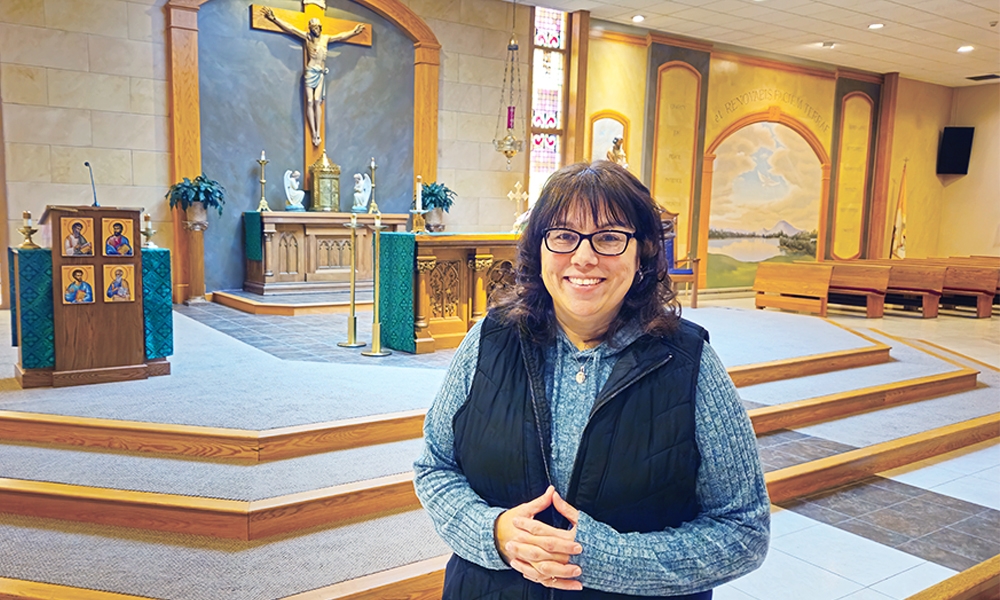
From Closure to Communion
Cara Pond and the Promise of the Mission Field
Cara Pond and the Promise of the Mission Field
Change rarely arrives without disruption. For those formed by years of spiritual routine, the closing of a parish can feel less like the merging of faith communities and more like the dismantling of identity. Pope Benedict XVI once observed that Catholicism is not a refuge for comfort but a summons to greatness. C.S. Lewis likewise argued that authentic faith challenges ease and calls believers to confront difficult truths.
Such insights became more than abstract theology for Cara Pond. They became the interpretive lens through which she would eventually understand one of the most challenging seasons of her spiritual life when her own parish closed.
Change rarely arrives without disruption. For those formed by years of spiritual routine, the closing of a parish can feel less like the merging of faith communities and more like the dismantling of identity. Pope Benedict XVI once observed that Catholicism is not a refuge for comfort but a summons to greatness. C.S. Lewis likewise argued that authentic faith challenges ease and calls believers to confront difficult truths.
Such insights became more than abstract theology for Cara Pond. They became the interpretive lens through which she would eventually understand one of the most challenging seasons of her spiritual life when her own parish closed.
Shock and Disbelief
Originally from the Green Bay area, Cara moved to Virginia, Minnesota, with her husband 25 years ago. She now teaches at Rock Ridge and experienced school consolidation through the merger of local schools — an adjustment she says was easier to accept after having gone through a similar transition in her faith life.
Cara belonged to Sacred Heart Church in Mt. Iron when she learned the parish would be closing. The news felt sudden and deeply personal. “You wrap your identity up in your church,” she said. When the announcement letter arrived in the mail, her first reaction was one of shock and disbelief: How can they take my church from me?
She now describes her response with candor. Her disappointment hardened into resentment and her sense of loss became self-focused. Rather than viewing the closure as part of a broader diocesan plan, she saw only what she felt she had lost. She resisted the idea of attending Holy Spirit in Virginia, the nearest parish within the newly clustered arrangement. For a time, she resolved to stop attending Mass altogether.
Parish clustering had already linked Sacred Heart with neighboring communities, yet those connections had felt nominal. Bulletin updates from other parishes were easy to ignore because they were not, in her mind, “my church.” Her faith had become geographically tied to a single church.
Opening Her Heart
Her son Ethan adapted more readily. Like many young people, he demonstrated a flexibility that eluded older generations more resistant to change. His involvement in Totus Tuus, a youth program dedicated to evangelization and catechesis, required engagement with the wider parish community. Through him, Cara observed a different response to change — one marked not by resistance but by openness.
Even then, she remained hesitant. She acknowledges that pride played a role. Watching her son move forward, however, introduced a question she could not ignore: did she want to preserve comfort, or did she want to grow? The two, she realized, were not synonymous.
At Sacred Heart, her participation had been largely confined to weekly Mass, with occasional involvement in religious education. The closure, painful as it was, exposed a spiritual complacency she had not previously examined. Gradually, she challenged herself to consider attending Holy Spirit.
Her first visit felt awkward. She was unsure where to sit. Am I sitting in someone’s spot? she wondered. She questioned whether others noticed her unfamiliar presence. The experience was like entering a room where everyone already knew one another. That uneasiness lingered for several weeks, yet within six months, Holy Spirit began to feel less like foreign territory and more like home. Names replaced anonymous faces, and casual greetings grew into meaningful conversations.
Holy Spirit’s physical and cultural environment also differed from what she had known. A large gathering space encouraged interaction before and after Mass — something not available at Sacred Heart. Here, parishioners lingered and conversations extended beyond pleasantries. She began to perceive what an engaged faith community could look like.
Transformation required more than simply showing up; it demanded vulnerability. Cara chose to volunteer as a sacristan and extraordinary minister of holy Communion, making a deliberate decision to contribute rather than merely observe. Much to her surprise, this commitment led to personal growth. Trust in her own plan gave way to trust in God’s plan. In retrospect, she views the entire experience as a beautiful redirection. “Where would I be today if I had stayed on my own path?” she reflects.
The establishment of the Lumen Christi Mission Field — uniting parishes in Virginia, Eveleth, Gilbert and Aurora — expanded that redirection even further. What once seemed like a loss now revealed itself with new possibilities. Embracing the mission field, she discovered new relationships, new ministries and countless opportunities for her faith to grow.
Cara began attending Mass across the mission field, sometimes at Resurrection in Eveleth, other times at St. Joseph’s in Gilbert. The sense of competition between parishes soon faded. Parish identity became less about geography and more about shared faith. She describes the focus shifting from “my church” to “our Church.” Participation no longer revolved around a single building but around a collective mission.
Called to Do More
Her involvement continued to grow. She joined the Marquette School Board, helped plan parish events, participated in a women’s group, baked for faith formation and eventually launched a Bible study. What once felt intimidating became a clear expression of the mission field’s potential.
Though she had never led a study before, she felt a quiet invitation to step forward. Twenty women attended the first session — some from neighboring parishes, some Catholic, others returning after decades away and a few exploring the faith for the first time. Their presence reflected the wide reach of the mission field. Aware of her limitations, she prepared diligently and prayed before each meeting.
What began as a single study soon became something far greater. The first session proved deeply fruitful, and a second drew 30 women, requiring multiple small groups over 22 weeks. Now in its fourth year, the program has become a steady gathering place for women at every stage of faith.
Along the way, two truths emerged: every spiritual journey is distinct, and every person carries something worth offering. As participants began to recognize one another across parishes and backgrounds, barriers softened and friendships formed. Structured catechesis gradually gave way to authentic community — she now saw the mission field not as a reluctant merger but as a deliberate weaving together of diverse gifts within one shared faith.
Cara’s son is now in the seminary. His vocational discernment required a similar departure from familiarity. Both mother and son came to understand the same truth: God does not necessarily call the equipped; He equips those He calls. Resistance often originates not in circumstance but in the human will.
Letting God Lead
Looking back, Cara does not romanticize the closure of Sacred Heart. She loved that parish. She acknowledges the legitimacy of grief. What changed was not the past, but her posture toward the future. Her willingness to trust that God could work through the loss. She now approaches uncertainty with a different question: How might God bring good from this?
Her story illustrates that change, though difficult, can bear spiritual vitality when embraced rather than resisted. The Lumen Christi Mission Field stands as evidence that distinct communities can come together as one without losing their identity. Properly understood, this shared mission can foster a broader, more dynamic expression of Catholic life.
“Where would I be today if I had stayed on my own path?”
Cara once could not imagine entering another church, even within her own city. Today, she looks forward to visiting new parishes, attentive to the distinct charisms each community offers. She has come to see that faith is larger than any one building and that community extends beyond a single parish.
The door that closed in Mt. Iron was not an ending, but an invitation — one that required surrender and the courage to leave behind what she had always known. In time, she embraced life in a new parish and discovered a deeper expression of her faith there. The emergence of the mission field invited her once again to stretch, to trust and to grow. What began as a difficult transition ultimately became a pattern of continual renewal — each new step drawing her further into the life of the Church.