A Beautiful Tragedy
How suffering brought the Herringshaws into the Catholic Church
How suffering brought the Herringshaws into the Catholic Church
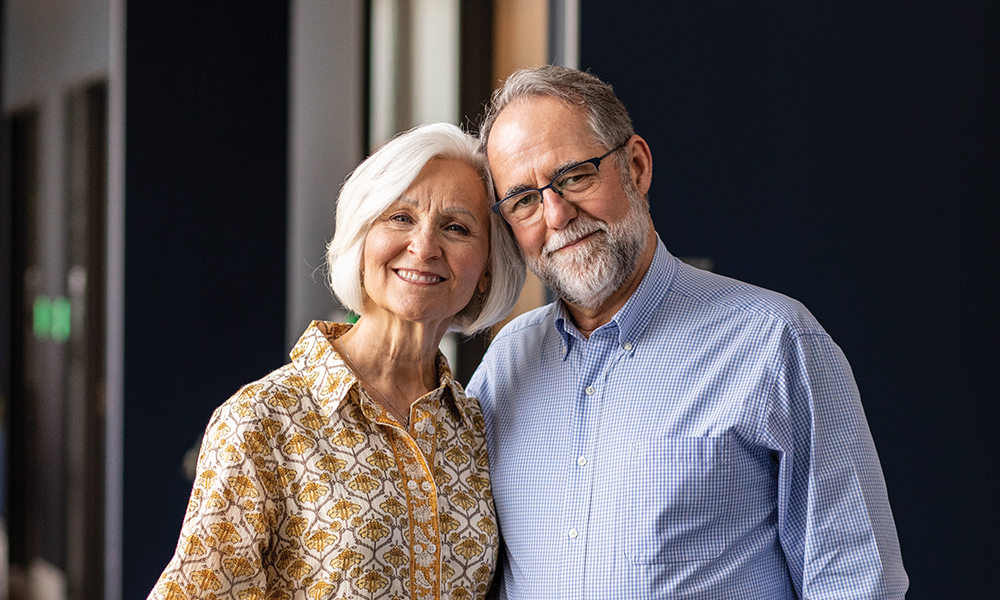
The circumstances that draw individuals to the Catholic Church often unfold in unexpected ways. For Mark and Jill Herringshaw, their journey was shaped by a convergence of influences, though it was ultimately a season marked by suffering and loss that opened their hearts most profoundly.
Jill grew up in South Minneapolis within the Baptist General Conference tradition. She recalls that Catholics were not always viewed favorably in her upbringing — an attitude she now regrets. After attending Catholic weddings and funerals, she admits they often spoke about Catholics with an unwarranted sense of arrogance.
Mark’s upbringing led to a similar distance from Catholicism. Raised in Santa Cruz, California, he came from a long line of Methodist pastors — his father, grandfather and great-grandfather all served in ministry. In his world, the Catholic Church was simply not considered. What exposure he did have left him unconvinced, especially when many of his Catholic peers seemed unsure of their own beliefs.
Mark and Jill met in college in California and married soon after, beginning a shared life in ministry. They joined a Protestant mission agency in Canada, but, after three years, returned to California, where Mark stepped into pastoral ministry in the Methodist tradition while completing his ordination. Together, they built a life centered on faith, ministry and family — eventually welcoming four children: Emily, Elisabeth, Matthew and Michael.
For a time, it seemed like they had found their place.
A Crisis of Belief
Beneath the surface, questions were beginning to stir. As they would later come to discover, God often works most powerfully through the paths we never intended to take.
Mark’s theological tensions first emerged around the sacraments — particularly baptism and Communion. In the Methodist tradition, these were viewed as symbolic ordinances. Mark became increasingly unsettled by that understanding. The Lord’s Supper, he sensed, contained a deeper reality than mere symbolism. This conviction led him into a deeper study and, eventually, he could no longer reconcile his growing beliefs with his role in Methodist ministry.
Together, he and Jill discerned a move to Minnesota, where they joined a multi-site charismatic Lutheran church in the Twin Cities. Mark joined the staff, attended Luther Seminary and successfully transferred his ordination into the Lutheran tradition. He eventually became the lead pastor of one of the worship sites, with Jill serving in music ministry.
For a time, this seemed like a resolution.
By 2010, a deeper crisis began to emerge — what Mark referred to as a “crisis of ecclesiology.” He began to question the very nature of the Church. Why did it exist in this form? Could it simply be replicated online? Why the buildings, the structures, the staff? More importantly, what was the Church, beyond supporting individual relationships with God?
The more he searched, the more he realized there was no substantial theological framework to answer these questions within his experience. In time, he stepped away from vocational ministry altogether.
Concurrently, his intellectual journey took him deeper into the study of the human person. In that exploration, he encountered the writings of Karol Józef Wojtyła — Pope St. John Paul II — and Edith Stein. Their reflections on the human person, dignity and the sacredness of being provided something he had been searching for but could not yet name. He didn’t fully realize where this would lead, but in hindsight, it planted important seeds.
A Nightmare They Could Not Stop
In 2010, everything changed.
Their eldest daughter, Emily — a gifted and vibrant young woman studying ballet on scholarship — was involved in a serious car accident and sustained a concussion. In the months that followed, her personality began to shift. While no definitive link could be proven, the timing was difficult to ignore. What followed was a devastating 10-year spiral.
At times, Emily seemed stable, but those periods were often followed by sudden disappearances and deep instability. Because she was legally an adult, Mark and Jill found themselves powerless to intervene. Evidence suggested she had become entangled in dangerous and destructive circumstances. Mark later described it as a parent’s worst nightmare unfolding in real time — one they could not stop.
The suffering intensified when Emily discovered she was pregnant with twins. During an attempt to escape her situation, she went into labor prematurely at just 24 weeks. Alone and in distress, Emily managed to reach St. Joseph’s Hospital in Denver and called her parents. Mark and Jill flew out immediately.
The first baby girl was born weighing just over one pound — no larger than the span of Mark’s hand. Doctors prepared the family for the likelihood that she would survive only minutes. Jill noticed that the medical staff had put away their instruments after the delivery, as if the outcome had already been decided.
In that moment of powerlessness, their only recourse was prayer.
What unfolded defied every expectation. Ten hours passed, and she was still alive.
Jill pleaded with the nurses for help. When a pediatrician finally entered the room, the tiny infant let out a faint cry. The doctor hesitated. “She shouldn’t be able to do that,” he said. “She doesn’t have developed lungs.” He looked at the child. “Give her to me. This child wants to live.”
The baby was rushed to the NICU. They were warned to prepare for severe complications — brain damage seemed almost certain after so many hours without oxygen. When the doctor returned, his report was startling. Her oxygen levels were normal. Her glucose levels were stable. He could not explain it.
Against every expectation, she survived.
A week later, the second twin girl was born. Both girls spent three months in the NICU, with one undergoing heart surgery during that time. Both survived. Both are thriving today.
Even in the midst of this miracle, uncertainty remained. Emily warned her parents that they were not safe and urged them to leave. She believed the father would come looking for them. What followed was a painful and complicated journey — temporary reunions, renewed threats and eventual intervention by authorities. The girls were placed into protective custody and then entrusted to Mark and Jill as foster parents.
Their questions about Emily remained unanswered. They did not know where she was or whether she was safe.
A long and difficult legal battle ensued. Despite their deep bond with the children, the guardian ad litem raised concerns about their faith background and ability to be “objective” care-givers.
In the depth of this struggle, their son Michael and his wife Jenna revealed that they felt God was calling them to adopt the twin girls. After prayer and discernment, Michael and Jenna moved into Mark and Jill’s home, gradually forming their own bond with the girls. For Mark and Jill, stepping back was deeply painful — yet, as Mark described it, “beautifully painful.”
23 Minutes
In July of 2019, another trial arrived.
Early one morning, while out for a run, Mark collapsed. A buildup of plaque in his left anterior descending artery had ruptured, sending him into cardiac arrest. Jill found him unresponsive and began CPR immediately. When paramedics arrived, they could not restore a heartbeat. They used a defibrillator nine times. For 23 minutes, Mark had no detectable heartbeat, until suddenly a faint rhythm returned.
He was rushed to the hospital, where doctors inserted multiple stents before placing him into a medically induced coma. Physicians anticipated that he would remain in that state for at least nine days. Even if he survived, they warned there was only a 1 percent chance of life, and virtually no chance that his brain or kidneys would function normally.
Yet once again, the family’s guardian angels were at work.
The very next day, Mark woke from the coma.
Within 10 days, he was in occupational therapy. A few days later, he was discharged — without lasting damage. Before he left, one of his physicians sat at the edge of his bed and told him plainly: There was no sufficient medical explanation for what had happened. The only fitting word was miracle.
The 200-Pound Obstacle
Even as these trials unfolded, Jill was being drawn in a new direction. Through Catholic friends, she encountered an approach to suffering she had never seen before — the practice of “offering it up.” When she asked what that meant, a friend wrote out a simple prayer. Reading it, Jill understood for the first time that her suffering could be meaningful rather than merely endured.
She discovered the Divine Mercy Chaplet and found herself clinging to it in moments when words failed. She told God, with a touch of humor, “Lord, I know this is Catholic — but it’s working.” In that prayer, she found a steadiness and peace she had been searching for.
She began to notice differences in what she was being taught at her church. When told she no longer needed to repent because Christ had already done everything, something didn’t sit right. She sensed a lack of authority and clarity. In contrast, her Catholic friends carried a deep conviction and a peace she longed for.
Eventually, one Mothers’ Day, Jill made the decision to attend a Catholic Mass.
Inside the church, Jill found herself transfixed by the large crucifix above the altar. She could not look away. She reflected on Christ’s suffering — on what He endured for her. She listened attentively to the readings, the homily, and the rhythm of the liturgy. When Mass ended, she stayed in her seat. “I love this,” she thought. She was enthralled, completely in love with it all.
Afterward, she realized that what she had encountered was not something she could easily walk away from. She began to long for the Eucharist and a relationship with Mary.
Jill met with a parish priest and learned about an upcoming OCIA class, which she immediately agreed to attend. However, Mark — her husband, a seasoned Protestant pastor — would need to be part of the conversation. Jill referred to him, with some affection, as a “200-pound obstacle.”
The Sanctuary Candle
Mark was very resistant at first — “a curmudgeon,” as Jill describes him — but despite a long list of objections, he agreed to explore OCIA with her. True to his nature, he threw himself into study. He revisited his earlier beliefs and found new questions emerging. His old crisis of ecclesiology resurfaced — but this time, answers were waiting. The Catholic Church appeared to him as something coherent, historical, and unified in a way he had not previously encountered. The papacy, the structure of the Church, its continuity through history — all of it aligned.
Still, this realization came with cost. Mark had a public ministry, published works and a wide influence. This was not a private shift.
Then came one defining moment that brought everything into focus.
On July 17, 2022 — three years to the day after waking from a near-fatal heart attack — Mark attended Mass following OCIA. During the liturgy, something broke open. He experienced, in a way difficult to put into words, the reality of heaven intersecting with the present moment: the worship, the saints, the Eucharist, the wedding feast of the Lamb.
And something else fell into place. When Mark had first regained consciousness after his coma, he remembered seeing a mysterious red light — something he had never been able to explain. Standing in the church that day, he recognized it: the sanctuary candle burning beside the tabernacle. What he had glimpsed while emerging from near-death was the Mass.
He knew he wanted to be Catholic.
A Beautiful Story Inside a Terrible Tragedy
Six months after Mark and Jill entered the Church, their daughter Emily died by suicide on Good Friday.
The loss was immeasurable. The questions, once again, were difficult. Yet the way they carried that grief was different now.
“The Catholic understanding of death becomes hope,” Mark says. “Had we not had the Church to walk through this with us, who knows where we’d be?”
Today, Mark and Jill are in diaconate formation. They pray the Liturgy of the Hours and the Rosary daily. Looking back across all they have endured, Mark sees not a series of misfortunes but the steady hand of God — present in every miracle, every loss, every question that finally found an answer.
“It’s a beautiful story,” Mark reflects, “wrapped inside a terrible tragedy.”
“All of these struggles and sufferings,” he says, “I now see as God slowly softening my hardened heart. He was always at work in our lives, through both joy and suffering.”
All along, He was present — leading them home.