Something Worth Fighting For
A revival is taking place in the Catholic Church, and many of the faces filling parish pews and OCIA classes belong to young men.
A revival is taking place in the Catholic Church, and many of the faces filling parish pews and OCIA classes belong to young men.
Across the country, members of Generation Z are entering the Church in growing numbers, drawn by a desire for stability, purpose, truth and belonging. Although each conversion story is unique, many young men speak of searching for meaning in a culture that often feels disconnected, longing for something lasting and finding purpose in a cause greater than themselves.
Across the country, members of Generation Z are entering the Church in growing numbers, drawn by a desire for stability, purpose, truth and belonging. Although each conversion story is unique, many young men speak of searching for meaning in a culture that often feels disconnected, longing for something lasting and finding purpose in a cause greater than themselves.
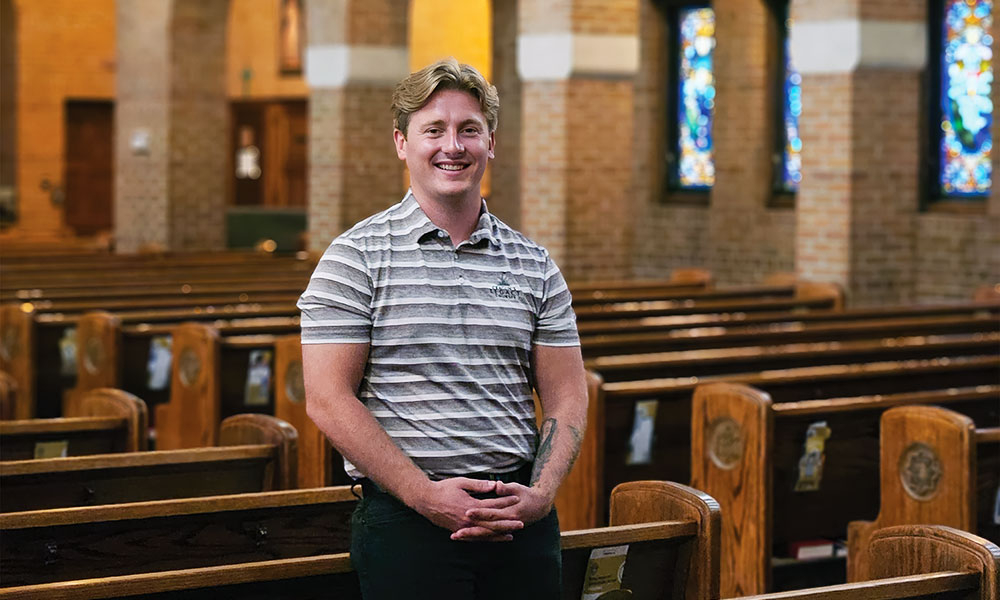
For Mason Oland of Brainerd, that search led him through years of rebellion, addiction, intellectual questioning and, ultimately, into the Catholic Church.
Growing up, Mason’s family belonged to the Evangelical Lutheran Church. He remembers a happy childhood filled with supportive parents, Sunday school and regular church attendance. Some of his fondest memories involve getting ready for church with his father, a successful businessman who would help him dress in his Sunday best while singing ZZ Top’s “Sharp Dressed Man.” Sometimes, his father would even let him wear a little cologne.
“I thought I was something special,” Mason said with a laugh. “Believing I was that sharp-dressed man.”
Even as a child, however, he found himself wrestling with questions. Mason recalls noticing practices within the Evangelical Lutheran Church, including female pastors and gay marriages, that gave him pause. Something about those practices, he said, didn’t sit right with him.
By seventh grade, rebellion had become a defining part of his life. Like many teenage boys, he wanted independence more than guidance. He began drinking, smoking marijuana and spending less time thinking about God. Faith was never completely absent, but it was largely pushed aside as he pursued whatever seemed exciting in the moment.
Yet even during those years, belief remained stubbornly alive within him. During a conversation with a self-proclaimed atheist at a party, Mason found himself defending Christianity. The irony was not lost on him. There he was, a teenager holding a case of beer while passionately arguing for the existence of God. Looking back, he sees the moment as proof that no matter how far he drifted from faith, he never truly stopped believing.
The contradictions of those years often followed him. Some Saturday nights stretched into Sunday mornings, yet he would still show up at church to teach 4- and 5-year-olds about Jesus. He jokes that people in his hometown sometimes compared him to Dennis the Menace because he could put on a charming front for adults while revealing a very different side of himself elsewhere. “I could play two different characters very well,” he said.
During college, Mason fell into a depression. The disruptions caused by the pandemic only amplified his struggles. When his college shut down and students were sent home, Mason never returned. His drinking intensified, and by age 21 he found himself unable to escape the destructive cycle. He struggled to hold jobs, had little direction and increasingly felt trapped by habits he could no longer control.
One evening, he finally admitted to his parents that he had been drinking heavily for quite some time and didn’t know how to stop. Their response surprised him.
“Yeah, buddy, we know.”
What Mason believed he had hidden was obvious to everyone around him. His addiction had transformed him into what he now describes as a “tornado,” leaving chaos behind wherever he went. The situation eventually reached a breaking point when his mother told him he could either stop drinking or find somewhere else to live.
His pride chose the second option.
With nowhere to go and no money to support himself, Mason soon realized he had run out of answers. Too embarrassed to ask friends for help and unable to make it on his own, he returned home and pleaded with his mother to take him back.
Scheduled to enter treatment the following morning, Mason sat awake in his bedroom in the late hours of the night, suffering through alcohol withdrawal. He was cold and sweating at the same time. Thoughts about the life he had squandered raced through his mind. He remembered being a young man with enormous potential and wondered how things had fallen apart so completely. Then, in the midst of those racing thoughts, he experienced something he still struggles to explain.
Around 3 a.m., as he lay awake in the grip of withdrawal, Mason sensed what felt like the door to his room opening. He describes a presence entering the room and an immediate feeling of peace washing over him. Even now, recalling the moment gives him chills. The anxious thoughts that had been racing through his mind suddenly quieted. He remembers beginning to pray, “God, if this is You ...” but cannot remember what he said after that. Before the prayer was finished, he drifted off to sleep. For Mason, it was an encounter that marked the beginning of his return to faith.
Whether dramatic or quiet, conversion stories often contain a moment when God breaks through old assumptions and opens a new path forward. For Mason, this was that moment.
The next morning he entered treatment. There, amid the difficult work of recovery, he came to a simple realization that if he was going to rebuild his life, God needed to be part of it.
After treatment, Mason began searching for a faith community. Living in the Twin Cities at the time, he visited various Protestant churches, attended Bible studies and became involved with young adult groups. Yet he remained unsettled. Many of the church services felt more like concerts than worship services, and he often left feeling that the experience wasn’t taking him any deeper in his faith. He was looking for something with greater substance.
Around this same period, Mason often reflected on the image of the Blessed Mother weeping tattooed on his arm. The image resonated with him because it reminded him of his own mother, whose prayers and hope never wavered despite his struggles. Though he was not Catholic, he says he had always felt a deep reverence for Mary.
He began asking deeper questions about the Catholic Church. Much of what he thought he knew came from conversations with Protestant friends, many of whom claimed Catholics were not truly saved. Those arguments never sat well with him. Mason realized he had spent years hearing what others said Catholics believed without ever asking a Catholic himself.
As he began studying Catholic history and apologetics, one question kept returning: If the Catholic Church was wrong, what did that mean for the 1,500 years of Christianity before the Protestant Reformation? Martin Luther founded Lutheranism. John Calvin founded Calvinism. John Wesley founded Methodism. Asking who founded the Catholic Church ultimately led Mason back to Christ and the apostles. The deeper he looked, the more compelling the historical case became.
For many young men today, truth matters. Amid a culture where institutions are often questioned, Mason found himself persuaded by the Catholic Church’s claim to direct continuity with Christianity’s earliest foundations. Yet intellectual conviction and personal commitment are not always the same thing. Although he had become increasingly convinced by what he was learning, he still lacked the courage to attend Mass alone. That changed in the most ordinary of places.
While working at Costco, a customer noticed Mason’s tattoo of the Blessed Mother and asked if he was Catholic. When Mason explained that he was not Catholic but had been exploring the faith, the stranger invited him to attend Mass. That invitation led to a meeting which included Dan Johnson, director of faith formation at St. Francis Catholic Church in Brainerd.
One by one, many of the misconceptions he carried about Catholicism were addressed. Those conversations led him into OCIA, where he continued studying the faith and asking questions. At one parish question-and-answer session with a priest, he recalls being virtually the only person raising his hand. After years of searching, he wanted to know everything.
Standing before the bishop at the Rite of Election was a significant milestone, but Mason’s journey reached its fulfillment at the Easter Vigil, when he was received into the Catholic Church. The moment marked the end of a path he never imagined taking as a younger man who insisted he would never become Catholic. Even so, on the night before his confirmation, he asked himself one final question: “Do you just want to say you’re Catholic, or do you actually want to be Catholic?” After all the searching, questions, and prayer that had led him there, the answer was unmistakable.
Mason’s story mirrors a trend unfolding across the country as increasing numbers of young men are drawn to the Church in search of meaning, purpose and truth. For him, the sacraments, the beauty of the Mass and the Church’s enduring history provided the foundation he had been seeking for years.
“My faith is the most important thing in my life,” he said.
Looking back, Mason sees signs of God’s presence throughout his journey, even during the years when he was trying to ignore Him. He laughs now when remembering how confidently he once declared he would never become Catholic. For a young man searching for something worth fighting for, the answer arrived in the most unexpected place: the Catholic Church.