A Legacy Woven in Green
The Irish Priests Who Shaped the Diocese of Duluth
The Irish Priests Who Shaped the Diocese of Duluth
For more than a century, the Diocese of Duluth has been faithfully shaped by a remarkable thread of Irish heritage. What began as a common trend in the wider church—the journey of missionary priests who left Ireland to serve far‑flung dioceses—became in Duluth something more intimate: a family tradition, passed from uncle to nephew across generations and across oceans.
The diocese’s very foundations carry this Irish imprint. Its first bishop, James McGolrick, received his formation at All Hallows Seminary in Dublin, one of Ireland’s legendary training grounds for missionary priests. It was an institution whose influence would echo for decades in northern Minnesota.
The Duluth diocese witnessed something unique. Again and again, Irish priests who arrived in the early 20th century were later joined by nephews ordained decades afterward—sometimes serving more than 40 years apiece. The result is a lineage of vocations that spans continents, generations, and more than a century of ministry.
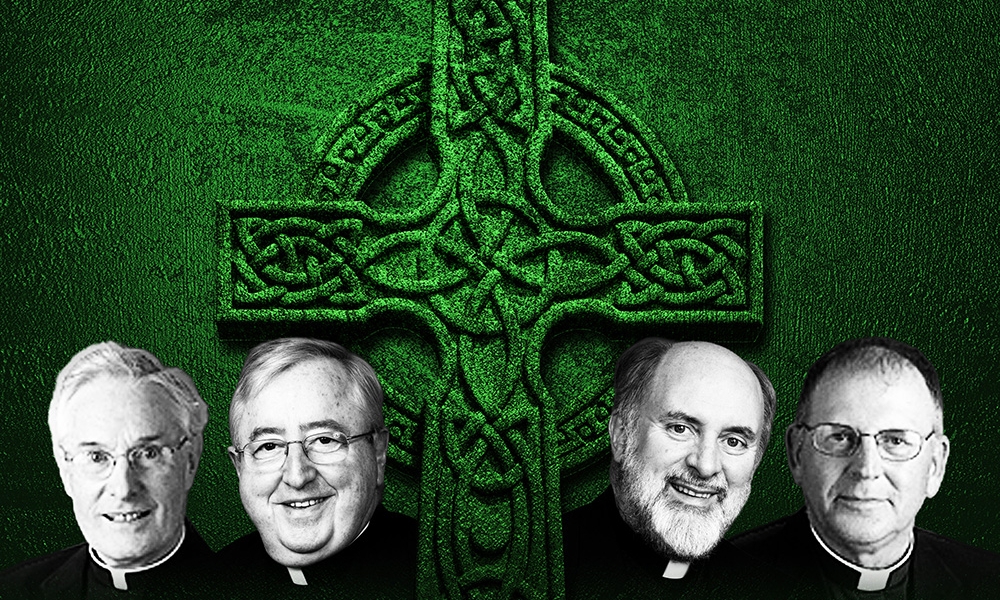
Below are four of these families—four stories of faith, migration, and a shared love for the Church in northeastern Minnesota.
The Boland Legacy: Building, Shepherding, and a Love for Children
Few priests have left a structural and pastoral mark as deep as Msgr. Michael Boland, a Tipperary native ordained for Duluth in 1912. Pastor of St. John the Evangelist for an astonishing 46 years, he oversaw the building of the church itself and spent 45 of those years directing the adjacent St. James Children’s Home—a ministry his nephew, Father Eamonn Boland, believes was “the great love of his life.”
Msgr. Boland’s leadership extended to the highest levels of the diocese. He served as vicar general under three bishops and, remarkably, was believed to have held the title of prothonotary apostolic longer than any other priest in the nation at the time of his golden jubilee in 1962.
His nephew, ordained in 1969, followed him from Ireland after years of hearing stories of Duluth around the family home. Though their time in ministry overlapped only briefly, Father Boland regularly visited his uncle at St. John’s:
“We come from a big family,” he recalled. “So we had lots of relatives to talk about.”
Together, their years of service total nearly 119—more than a century of Boland care for the people of northern Minnesota.
The Flynn Line: From Leitrim Fields to the Iron Range
County Leitrim provided Duluth with two tireless priests in Father Patrick Flynn and his nephew Father Charles Flynn, both shaped by the missionary spirit of All Hallows Seminary.
Father Patrick arrived first, ordained in 1925. Over the next 45 years he served parishes across the diocese and founded St. Christopher Church in Pequot Lakes. Known for his pastoral warmth, he left a deep impression on a young Charles during his long summer visits back to Ireland.
“He sailed home every three years,” Father Charles remembered. “He’d stay with us for three months.” When Father Charles finally arrived in Duluth in 1969, the two overlapped in ministry for about a year and a half—visits that included the gift of Pabst Blue Ribbon and rides in an enormous Buick Wildcat.
Though his uncle’s example mattered, Father Charles said the spark of his own vocation also came from the era’s new Catholic president, John F. Kennedy. After retirement in 2015, he split his time between Minnesota and Arizona, bringing the Flynn family’s combined service to nearly 102 years.
Msgr. Scott and Father Lyons: Stories, Letters, and a Minnesotan Calling
The relationship between Msgr. Thomas Scott of County Mayo and his nephew Father Michael Lyons is one of stories—stories told, stories written, and stories that inspired a vocation.
Msgr. Scott served throughout the diocese for more than four decades and was named a monsignor in 1961. His visits home to Ireland left a deep impression on a young Michael Lyons, who recalled evenings filled with tales of Minnesota life and parish ministry.
“He spoke highly of the life of the Church here,” Father Lyons said, “the deep faith and support of parishioners … and the friendship of many Irish-born priests already serving here.”
Notably absent from those stories: any mention of Minnesota winters.
Letters flowed between them during Father Lyons’ seminary years, including a particularly persuasive one when he entered All Hallows. Sadly, Msgr. Scott died just six months before his nephew was to begin his diaconate assignment in Brainerd.
Together, this uncle and nephew account for nearly 98 years of service.
The Spain–Walsh Tradition: A Century of Priesthood and a Shared Migration Story
The final pair—Father Henry Spain and Father Seamus Walsh—bookends one of the longest combined lines of service in diocesan history: 120 years.
Father Spain, ordained in 1918 from Tipperary, served a wide swath of the diocese before retiring in 1968. His nephew, Father Walsh, followed him from Ireland because he wasn’t needed in his home diocese—and because his uncle was already in Duluth.
“Had he not been here, I would never have heard of such a place as Duluth,” Father Walsh said.
The two overlapped in ministry for several years and attended the same seminary 50 years apart. Yet Father Walsh says he often wishes he had asked more questions during those early years—including what Minnesota winters were like.
A Heritage That Continues to Shape the Diocese
Between these four families, more than 400 years of priestly service have been given to the Diocese of Duluth. Their witness shaped parishes, built churches, administered diocesan offices, guided councils, supported orphanages, and touched countless lives.
Their greatest legacy may be the reminder that the Church is built not only by individuals but by families—families of faith, families of vocation, and families willing to cross the ocean in hope and service.
The Diocese of Duluth was shaped by their accents, their heritage, their humor, and their dedication. And in many ways, the echoes of Ireland still ring through the Northland because of them.