
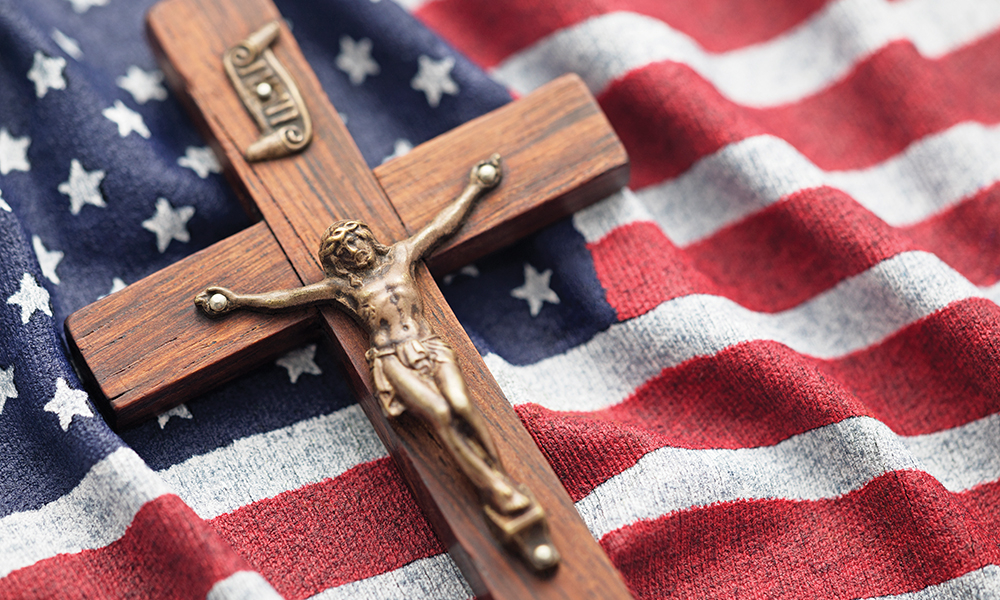
Catholic Patriotism
“If men were angels,” James Madison wrote in Federalist No. 51, “no government would be necessary.” As our nation marked the 250th anniversary of the United States’ founding with the Declaration of Independence, we did so at a time when the question of patriotism loomed large in the American consciousness. People have become disillusioned with America on both the political left and right, especially as we see the myriad imperfections in our history and the institutional organization of today. Yet, those words written by Madison are a worthy point of our consideration on what it means to be a Catholic citizen. The truth is that humans are both fallen and political beings, meaning we necessarily take part in a political system and have a need of such systems on account of original sin.
Whether we like it or not, Catholics are morally bound to be patriots, because the faith holds that patriotism is a moral virtue born out of the Fourth Commandment. Of course, this does not mean that our patriotism needs to be blind and unquestioning, because there’s a second part to Madison’s quote that often gets forgotten when people cite The Federalist Papers. “If angels were to govern men,” Madison continues immediately after the quote from above, “neither external nor internal controls on government would be necessary.” The Catholic Church recognizes patriotism as a duty of individual citizens that is owed to the political order in which they live. “The love and service of one’s country follow from the duty of gratitude and belong to the order of charity,” we read in the Catechism of the Catholic Church. Catholicism holds that patriotism obliges a Catholic citizen to contribute to the good of society in a spirit of truth, justice, solidarity, and freedom. As individual members of the United States, our citizenship obliges us to help our country be a virtuous and noble society.
The saying “my country, right or wrong” does not accurately reflect authentic patriotism. Yes, we are to love our country, but we also should be working to make our country lovable. When we find errors and offenses against the natural law, charity, creation, or any number of other ways in which our fallen political order can rebel against God’s ways, the patriotic response is to work to redress the situation. For 250 years, our nation — both in its leadership and its private citizenry — has made many atrocious mistakes and also been a stalwart defender of goodness. Such a situation is bound to continue thanks to the unchanging nature of mankind, but our role is to be humble patriots who seek to cultivate a culture of virtue in this time and place. Patriotism calls us to love our country not for its own sake, but for the sake of God, which is ultimately where we will find lasting peace and glory.
Father Nathaniel Meyers is pastor of Transfiguration Catholic Church in Oakdale, MN.